
WRITING · Sep 1, 2026
There’s a Reason This Place Is Called Well, Damnit.
Healthcare is hard enough without us making the work harder, the decisions slower, and the obvious problems somehow mysterious.
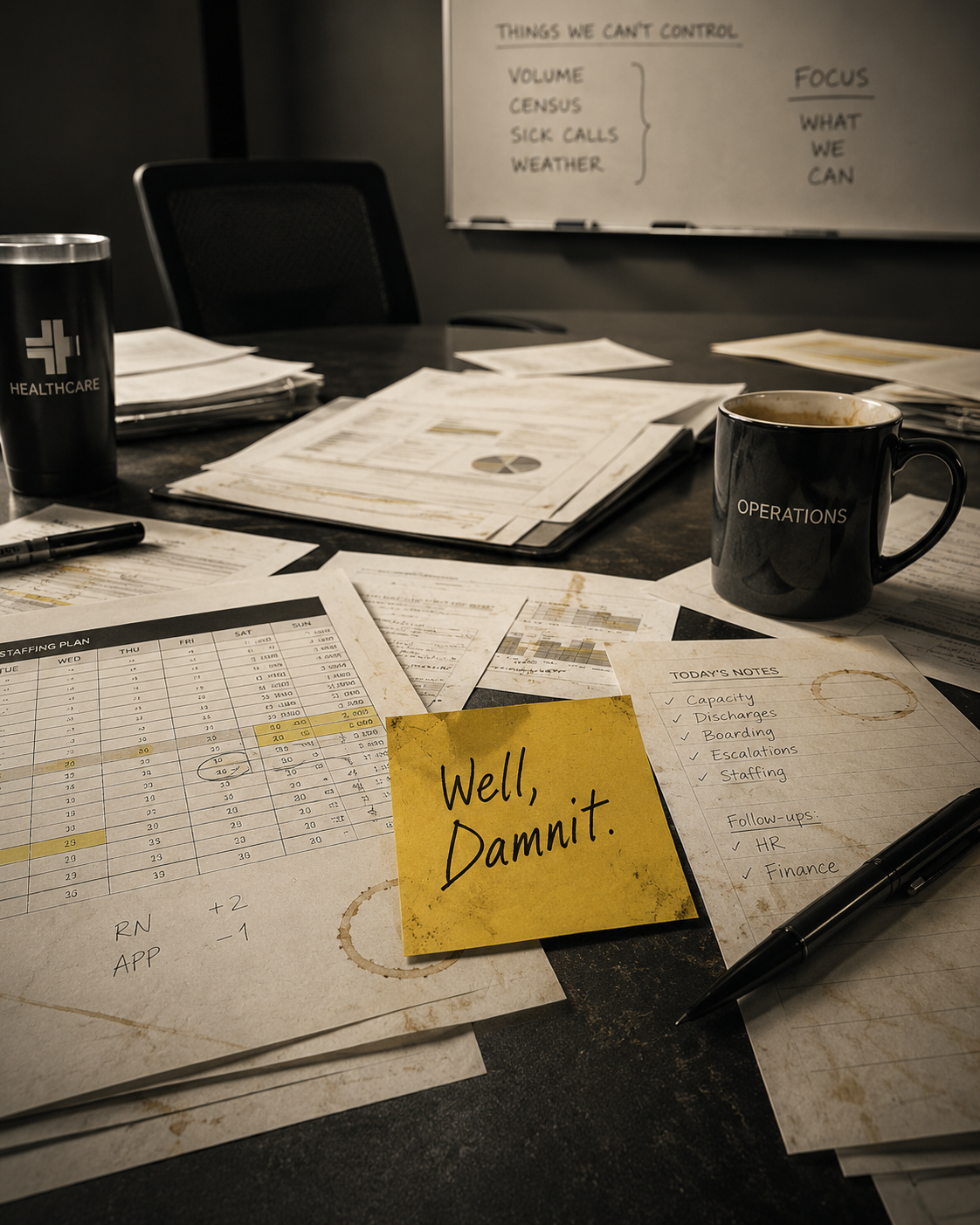
There is a phrase I have found myself saying with alarming regularity in healthcare: “Well, damnit.”
It is surprisingly versatile. It works when somebody resigns from a position everyone knew had been hanging by a thread for six months. It works when a “temporary workaround” quietly celebrates its third birthday. It works when a project that has been discussed in twelve meetings finally fails and everyone suddenly behaves as though an asteroid hit the building. It works especially well when someone opens a spreadsheet, looks at a number that has been moving in the wrong direction since March, and announces that we may have an emerging problem.
Well, damnit.
The phrase usually carries a little frustration, a little disbelief, and just enough resignation to acknowledge that regardless of how we got here, somebody still has to figure out what happens next. That is probably the best explanation I can give for why this place is called Well, Damnit.
I did not build this because I think healthcare is a disaster. I actually love healthcare operations. I find the work endlessly interesting because almost nothing about it exists in isolation. Staffing affects finance. Finance affects strategy. Strategy affects operations. Operations affect clinicians. Clinicians affect patient care. Technology touches all of it, usually while promising that the next upgrade will make everything easier. Add regulation, competition, workforce shortages, organizational politics, human behavior, and the fact that the work ultimately involves taking care of actual human beings, and you have an industry where even apparently simple decisions can become complicated very quickly.
Some of that complexity is unavoidable. A lot of it is not.
That distinction is where I get interested.
THE WORK BEHIND THE WORK
Organizations spend a tremendous amount of time talking about what they intend to do. We create strategic plans, operating plans, scorecards, dashboards, transformation initiatives, implementation roadmaps, and enough PowerPoint presentations to create a measurable burden on the national electrical grid. Much of that work is necessary. The problem is that eventually the presentation ends.
Then somebody has to make the thing work.
If the strategy says we are expanding a service, somebody has to recruit the people, build the schedule, get them credentialed, determine where they will work, make sure the technology is ready, explain what is changing, and figure out who owns the twenty-seven things nobody thought about until implementation week. If leadership says productivity needs to improve, somebody has to understand the work well enough to know whether the problem is staffing, workflow, volume, expectations, behavior, or a metric that made sense three years ago and has simply been copied forward ever since. If an organization decides it wants to improve access, somebody eventually has to answer the inconvenient question of who is actually going to see all of those additional patients.
That is the work behind the work.
It is the space between an idea and reality, and it is where I have spent much of my career. I have worked alongside physicians, APPs, clinical leaders, recruiters, administrators, coordinators, and plenty of people whose jobs are largely invisible until something they normally handle stops happening. I have watched very good ideas succeed because people understood the operation well enough to execute them. I have watched equally good ideas fail because nobody thought seriously about what implementation would require. I have also watched bad ideas survive far longer than they deserved because hardworking people kept compensating for systems that should have been fixed.
Those experiences have made me interested in questions that are often less glamorous than the strategy itself. Who owns this? What happens next? Does the staffing model actually match the work? Why does this process require seven approvals? What exactly are we measuring? Does anyone use that report to make a decision? Why are we still doing this manually? If everybody knew this was going to happen, why are we calling it unexpected?
None of those questions belong exclusively to executives, operators, or clinicians. They live in the space between all of them.
WHY WELL, DAMNIT. EXISTS
I wanted somewhere to talk about those questions without pretending every answer needs to sound profound.
Healthcare has no shortage of content about leadership, innovation, transformation, culture, disruption, and the future. Those are legitimate subjects, but sometimes the language becomes so polished that it stops describing anything recognizable. A department is not “navigating a dynamic workforce environment.” Three people quit and the schedule is screwed. The organization is not always “experiencing opportunities around decision velocity.” Sometimes nobody wants to make the damn decision.
Plain language has value.
So does nuance.
The opposite extreme is not much better. Healthcare conversations can quickly become a competition to determine who is responsible for ruining everything. Administrators are the problem. Physicians are the problem. Insurance companies are the problem. Private equity is the problem. Employees do not want to work anymore. Leaders do not understand the frontline. The frontline does not understand the business. Burn the whole thing down.
Reality is considerably more annoying because reality rarely gives us one villain.
There are excellent administrators and terrible ones. There are extraordinary clinicians and extraordinarily difficult ones. There are leaders who need to communicate better, employees who need to perform better, processes that need to be redesigned, and systems so poorly constructed that asking people to “take more ownership” is almost insulting. There are times when the data changes my mind and times when the data is technically correct but completely fails to describe what is happening inside the operation.
That is the kind of conversation I want here. Not cheerful nonsense. Not reflexive cynicism. The messy part in the middle where most of the actual work happens.
THE CONVERSATIONS I WANT TO HAVE
The podcast will be a major part of Well, Damnit., and I have very little interest in making it a parade of résumé interviews.
I want to talk to people who know things I do not know.
That includes healthcare executives and frontline operators, physicians and APPs, nursing leaders, recruiters, locum agencies, credentialing professionals, finance leaders, technology people, consultants who have actually implemented something, and people working in parts of healthcare I have not spent enough time understanding. I want guests who have built programs that worked, people who have watched good ideas fail, and people who are willing to say, “We tried that. Here is why it went badly.”
Most conversations will simply be me and one other person. I am not interested in manufacturing conflict by assigning people opposing positions and pretending we are hosting cable news for hospital administrators. Sometimes my guest and I will agree. Sometimes we will disagree. Sometimes I expect to walk into a conversation with a strong opinion and discover that the opinion does not hold up particularly well once somebody who knows more than I do starts talking.
Good.
Changing your mind because you learned something should not be treated like a professional emergency.
There are plenty of healthcare subjects worth examining this way. Is locum tenens too expensive, or are we sometimes comparing the cost of locums with an internal staffing model that does not actually exist? Are APPs being underutilized, or are we still struggling to decide what we want their role to be? Does healthcare have too many administrators, or do we have too many processes that require administration? Is physician productivity a performance problem, a staffing problem, a workflow problem, a volume problem, or some delightful combination of all four?
Those questions deserve more than a hot take.
THE WRITING WILL BE DIFFERENT TOO
Some ideas need more room than a podcast conversation, and certainly more room than a social media post.
This is where I want to write about healthcare operations, leadership, workforce, staffing, locums, physicians, APPs, productivity, execution, management, culture, and the organizational habits that make otherwise intelligent people collectively do very strange things. Some pieces will be analytical. Some will be practical. Some will probably begin because I saw something happen and thought, “There is absolutely no way this is the best way to do this.”
I am fine with that.
I also do not intend to write from the position that I have solved leadership or healthcare operations. I have not. I have made good decisions and bad ones. I have built things that worked, things that did not, and things I remain convinced would have worked beautifully if everyone else had simply recognized my genius in time. Unfortunately, that is apparently not an accepted implementation strategy.
Experience gives you perspective. It does not make you infallible.
I came into healthcare from outside healthcare, and I still value that part of my perspective. There are things this industry accepts as completely ordinary that would sound insane if you explained them to someone who had never worked here. Sometimes there is a good reason for that. Sometimes there is an old reason nobody has questioned recently. And sometimes the answer is simply that healthcare is remarkably good at turning yesterday's workaround into tomorrow's policy.
I want to keep asking which one it is.
WHO I HOPE FINDS THIS PLACE
Well, Damnit. is for people who care about how healthcare actually works.
That may mean you run a hospital, lead a medical group, manage physicians or APPs, work in nursing leadership, recruit clinicians, manage locums, credential providers, build technology, analyze finances, oversee quality, manage patient flow, or sit somewhere in the enormous operational machinery connecting all of those things. You may be early in your leadership career, or you may be sitting in an executive role wondering how something that should have been a two-week project is entering fiscal year three.
You may also be a clinician who thinks operations has no idea what your day looks like. There is a reasonable chance you are correct. I hope you stick around anyway.
What I do not want is a narrow little corner of the internet where everyone has the same job, uses the same terminology, and already agrees with one another. Healthcare is too interconnected for that. Some of the most useful conversations happen when someone from one part of the system explains a problem to someone who has only ever seen it from the other side.
That is the audience I want: curious people with enough experience to know the easy answer is usually incomplete.
HEALTHCARE IS HARD. STUPID IS OPTIONAL.
That sentence sits prominently on this site because I mean it.
Healthcare is legitimately difficult. The regulations are real. The workforce challenges are real. The financial pressures are real. Clinical risk is real. Patients are complicated, markets change, technology fails, and humans remain stubbornly unwilling to behave like clean rows in an Excel model.
We should respect that complexity.
What we should not do is use complexity as an excuse for every unnecessary process, delayed decision, useless meeting, outdated assumption, duplicate report, or badly designed system we inherited.
A process that requires fourteen steps may have a reason. It may also have six steps nobody has needed since 2017. A recurring meeting may be essential. It may also exist because nobody wants to be the person who cancels the meeting. A staffing model may reflect careful analysis. It may also reflect volume that disappeared two years ago. A dashboard may provide valuable information. It may also be a very expensive way of decorating a wall with numbers.
We should be willing to tell the difference.
That is not being negative. It is taking the work seriously enough to question it.
WHAT I WANT THIS PLACE TO BECOME
I want Well, Damnit. to be useful before anything else.
I want someone to hear a conversation and send it to a colleague because it finally put words around something their team has been struggling with. I want someone to read an article and reconsider an assumption. I want people who disagree with something here to explain why, preferably with enough substance that the disagreement teaches the rest of us something.
I want it to be smart without becoming impressed with itself. Serious when the subject deserves it. Funny when the situation deserves it. Comfortable admitting uncertainty. Willing to call something ridiculous when something is, in fact, ridiculous.
I have no ten-year master plan for what Well, Damnit. becomes. There will be a podcast. There will be writing. There will eventually be other things worth making. I would rather let those things grow because people actually want them than create an elaborate ecosystem on day one and spend the next five years explaining why it exists.
For now, the job is simpler.
Make something worth coming back to.
That seems like enough.
WHY THE NAME?
Because “Well, Damnit.” is usually not the end of the conversation.
It is the moment right before the useful part starts.
Well, damnit, the schedule is broken. What are we going to do about it?
Well, damnit, the project failed. Why?
Well, damnit, everybody saw this coming. Then why did nobody act?
There is frustration in it, certainly. There is also recognition. Whatever happened has happened. We can spend the next hour finding creative ways to describe the problem, or we can start figuring out what comes next.
I prefer the second option.
So this is the beginning: candid conversations, writing, and ideas about healthcare operations, leadership, and the work behind the work. Some of it will challenge things I believe. Some of it will probably challenge things you believe. If we are doing this correctly, both should happen.
Healthcare is hard enough already. We should stop volunteering to make it harder.
Well, damnit.
Here we go again.